The Last Days of the Sioux Nation by Robert M. Utley
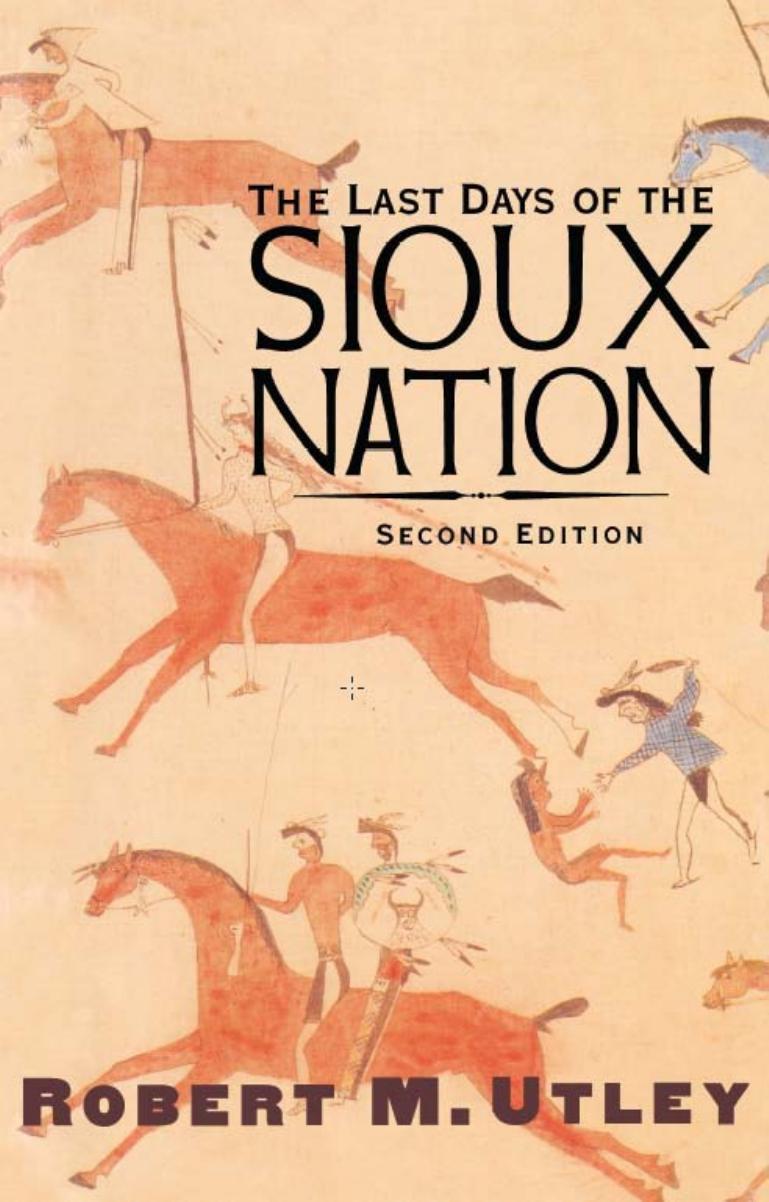
Author:Robert M. Utley
Language: eng
Format: epub, pdf
Publisher: Yale University Press
Published: 1963-06-23T04:00:00+00:00
News of Sitting Bull’s death had no discernible effect either upon the friendlies at Pine Ridge or upon the dancers in the Stronghold. Small parties of warriors from the Stronghold continued to range through the ranching country along the Cheyenne and to meet in harmless brushes with Colonel Day’s cowboy militia. While still trying to persuade a reluctant Miles to authorize a simultaneous offensive on the Stronghold from the north and south, Brooke prepared to mount another peace offensive. Fearing that Day’s men might complicate the effort, Miles ordered the colonel to keep his troops north of the Cheyenne. The plan was to send a force of 500 friendlies from Pine Ridge into the Stronghold to negotiate once more with the dancers. Preparations consumed most of the week following Sitting Bull’s death.
On December 22 a touch of humor relieved the tension at Pine Ridge. The Indian policemen hauled before Agent Royer a white man they had picked up wandering through the camps, a white blanket draped over his shoulders, preaching to all who would listen. He gave his name as A. C. Hopkins of Nashua, Iowa. The name was not unfamiliar, for he had recently acquired some notoriety by noisily advocating the pansy as the national flower. Now he quietly informed Royer, “I claim to be Christ, the Messiah, in a poetic sense, the same poetic sense in which Hiawatha, Socrates and General Grant are considered and esteemed the world over.” In fact, he had been trying for several days to convince the Oglalas that he was the Messiah prophesied by Wovoka. Since he could not speak their language, the Indians were not deceived, but they treated him with the respect and kindness customarily accorded the insane. Royer was less respectful. “Prove that you are Christ,” he demanded. “Give me more time among these Indians and I will,” was the answer. Said Royer, “I’ll give you just one hour to get out of town.” Within an hour, Hopkins was seated in a wagon bound for Rushville under police escort.7
Hopkins repaired to Sioux City, where he called at the office of the Sioux City Journal on December 24. After a long interview with a reporter who had nothing better to do on Christmas Eve, Hopkins left a note and departed. “To America and the world,” it read, “greeting: God’s peace be with you. The Messiah. Christmas Eve, 1890.”8
The Miniconjous revered Big Foot (also known as Spotted Elk) as one of the outstanding chiefs in their tribe’s history. His distinction rested less upon exploits of war than upon political and diplomatic triumphs. Success at negotiating peace between quarreling factions had earned him a reputation as the great compromiser of the Sioux, and other Teton tribes often sought his aid in patching up internal conflicts. Yet Big Foot was also uncompromisingly wedded to the old life, and this love of traditional ways had led him, in October and November 1890, to embrace the Ghost Dance in hope of restoring the old life. His people pitched camp with Hump on Cherry Creek and threw themselves wholeheartedly into the dance.
Download
The Last Days of the Sioux Nation by Robert M. Utley.pdf
This site does not store any files on its server. We only index and link to content provided by other sites. Please contact the content providers to delete copyright contents if any and email us, we'll remove relevant links or contents immediately.
| Africa | Americas |
| Arctic & Antarctica | Asia |
| Australia & Oceania | Europe |
| Middle East | Russia |
| United States | World |
| Ancient Civilizations | Military |
| Historical Study & Educational Resources |
Cat's cradle by Kurt Vonnegut(15362)
Pimp by Iceberg Slim(14519)
4 3 2 1: A Novel by Paul Auster(12398)
Underground: A Human History of the Worlds Beneath Our Feet by Will Hunt(12100)
The Radium Girls by Kate Moore(12033)
Wiseguy by Nicholas Pileggi(5791)
The Fire Next Time by James Baldwin(5452)
Perfect Rhythm by Jae(5409)
American History Stories, Volume III (Yesterday's Classics) by Pratt Mara L(5310)
Paper Towns by Green John(5194)
Pale Blue Dot by Carl Sagan(5012)
A Higher Loyalty: Truth, Lies, and Leadership by James Comey(4965)
The Mayflower and the Pilgrims' New World by Nathaniel Philbrick(4506)
The Doomsday Machine by Daniel Ellsberg(4492)
Killers of the Flower Moon: The Osage Murders and the Birth of the FBI by David Grann(4449)
The Sympathizer by Viet Thanh Nguyen(4396)
Too Much and Not the Mood by Durga Chew-Bose(4349)
The Borden Murders by Sarah Miller(4329)
Sticky Fingers by Joe Hagan(4204)
